
Three properties and an old office building to be demolished in Happisburgh

Date published: 14th April 2026
North Norfolk District Council, through the Coastwise scheme, has been working with homeowners of properties in the immediate coastal erosion risk zone in Happisburgh.
Each property owner was presented with a focused selection of options, including the sale of the property to the Council, to enable them to make informed decisions about their future.
Coastwise has worked with these property owners for several years and has helped them through the process.
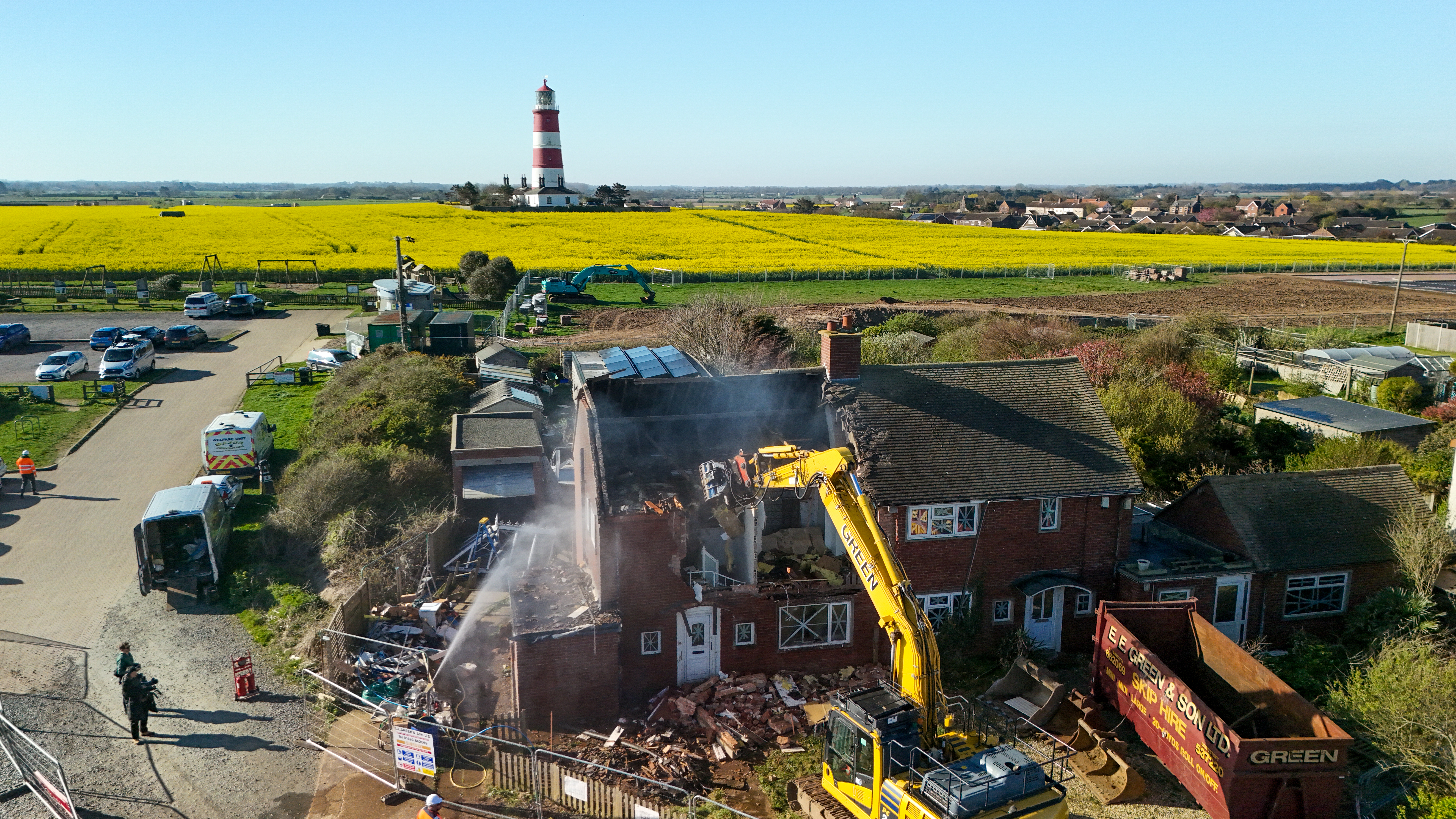
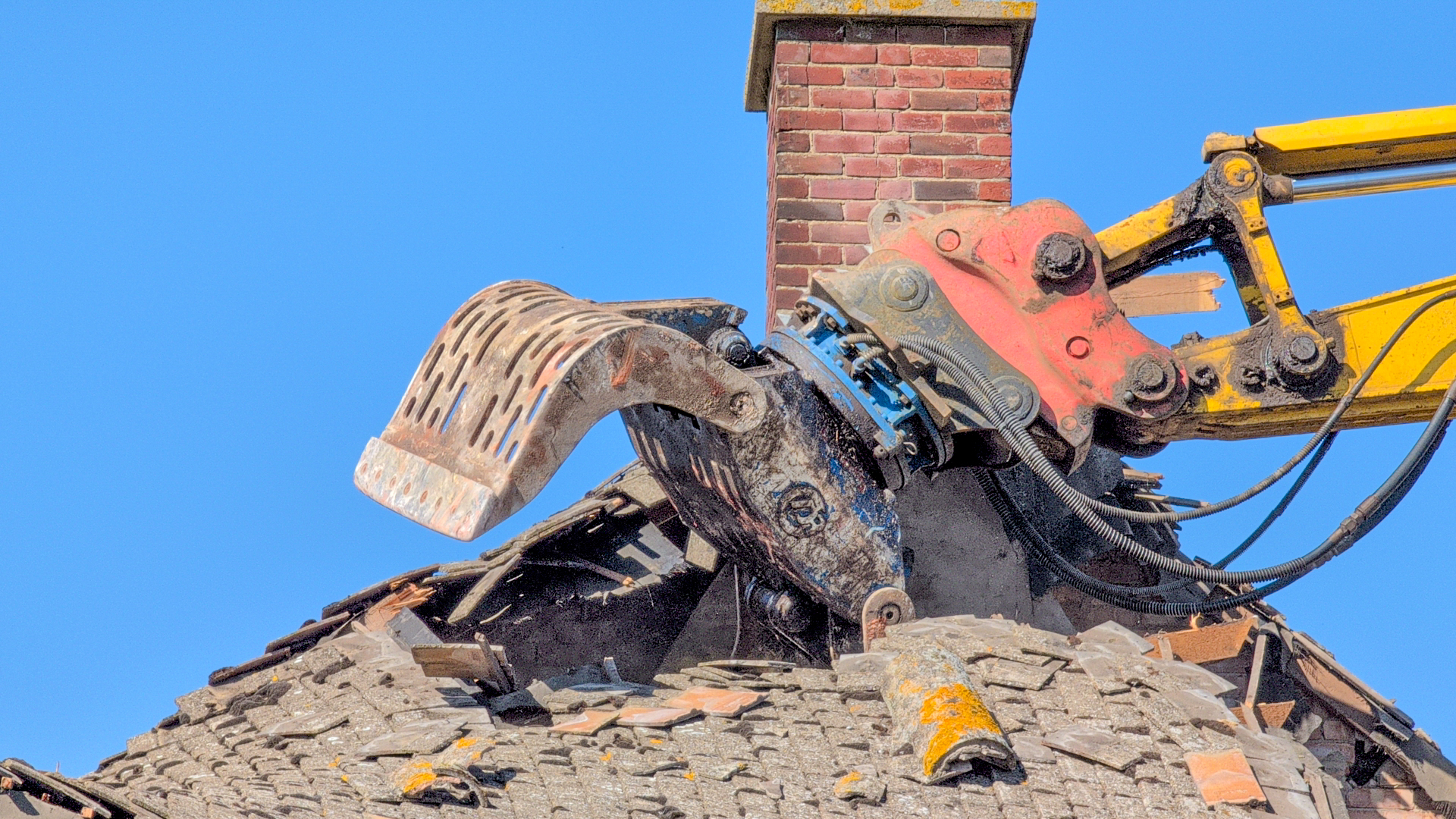
The three houses at immediate risk, located at the far end of Beach Road, have today started being proactively demolished.
The Council won’t comment on individual circumstances, but the previous owners have left the buildings and, in some cases, relocated with the support of the option they have chosen.
Demolition began on Tuesday morning with the property closest to the cliff.
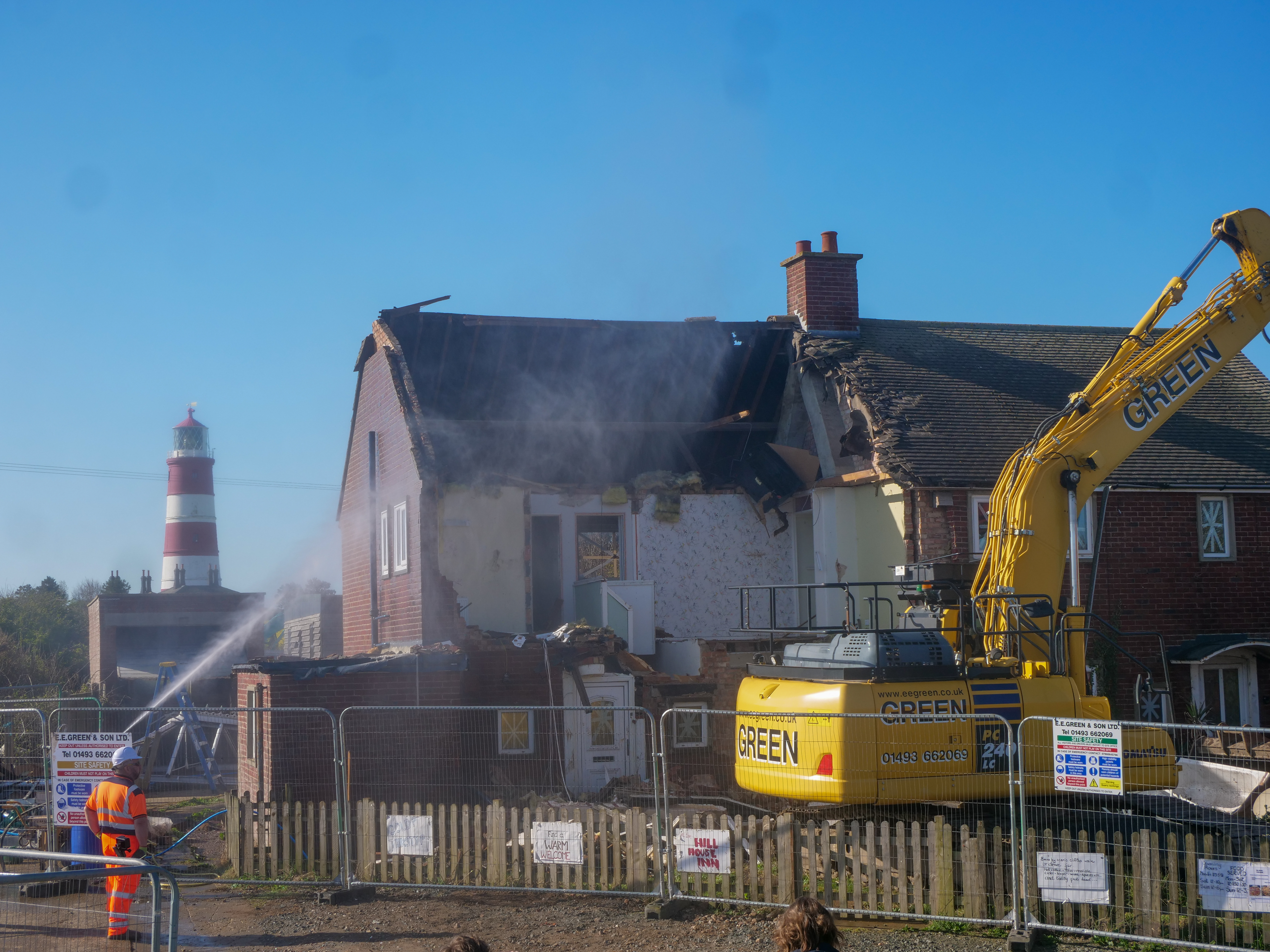
Along with the three properties, an old office building on the site of the old Manor Caravan Park (that previously relocated) will also be demolished. These demolitions are expected to last up to two weeks, subject to weather conditions and progress.
The Council has been able to support these demolitions financially through an existing, legacy fund it created a number of years ago for such eventualities and via the national Coastal Erosion Assistance Grant. Coastwise funding has supported homeowners through the options presented.
There is no home insurance for coastal erosion and the support options provided in this case are part of a trial, of which the learning will help shape how the government may support communities in the future.
Rob Goodliffe, Coastal Manager at NNDC, commented:
"At Happisburgh, we are taking down some properties at risk from coastal erosion.
"The difference here is it's being done in a planned way, i.e. in sufficient time to take controlled action and provide the owners with different options so that they can make plans and feel more prepared for the future whilst meeting their housing needs."
Coastwise is part of the Environment Agency/DEFRA Coastal Transition Accelerator Programme, an initiative working with individuals, communities, businesses, infrastructure owners, government, and others to explore and demonstrate how coastal places can plan and take action to prepare for and transition from coastal erosion risk. This Coastwise programme is providing local assistance whilst also delivering national learning to help shape how the nation supports and responds to coastal change in the future.
Find out more about Coastwise, including FAQs, at Home | Coastwise
Demolition of properties in Happisburgh – Q&As
Why is North Norfolk District Council demolishing these houses now?
NNDC, through the Coastwise project, provided the owners of these immediately at-risk properties with some focused options, above what would ordinarily be possible. The occupants have moved out of the properties before they are at imminent risk, enabling NNDC to demolish them before they reach or overhang the cliff edge.
What were the options presented to these property owners?
Ordinarily, the options for residents at risk of erosion are quite limited. Through Coastwise, we were able to support access to professional services – such as Planning, the ‘Planning Replacement Opportunity’, or through NNDC, offering to purchase the property at a set value.
How much money did they receive?
Occupants received between £40,000 - £100,000 to support them meet their needs.
Have the owners received support through the process?
NNDC, through Coastwise, has provided ongoing support for the property owners throughout the process. This has included officer time and expertise, access to wellbeing support, professional services where required, and demolition costs.
Have NNDC helped them find somewhere new to live?
Anyone in this situation can access support through the Council’s Housing Advice service if required. The additional options provided broadened the choices possible. Even with support, it is a very challenging situation for those concerned.
Whose responsibility is it to manage properties at coastal risk?
Ultimately, property owners are responsible for their own properties. North Norfolk District Council seeks to provide support where it can.
The Environment Agency have a national strategic oversight of Coastal Risk Management and North Norfolk District Council are the Risk Management Authority. This is primarily for strategic coastal policies (see the Shoreline Management Plans). Where it is not feasible to prevent the coast from changing, policies have identified a need to support communities to transition from coastal change. Coastwise is one of a small number of national projects seeking to explore how this may be best achieved.
Who is carrying out the demolition and how long will it take?
North Norfolk District Council has arranged the demolition. We have contracted experienced demolition contractors to complete the works. It is anticipated that the demolition will take approximately two weeks, with further time to sort and clear the materials.
How dangerous is this demolition, given its location – to contractors or to the public?
All demolitions need to be carefully managed and the contractors have assessed how best to carry out the work. Materials such as asbestos have been removed in advance. The proximity to the cliff is a factor that has been considered.
Who is paying for the demolition to be carried out?
Many residential properties (purchased before June 2009) qualify for a national government coastal erosion assistance grant. Where this is not possible, North Norfolk District Council is paying for the demolition through a fund it set up for such instances a number of years ago. The North Norfolk fund is now nearly exhausted and Coastwise is investigating how actions required for coastal transition can be funded into the future (e.g. how demolition is funded/financed in the future alongside many other possible interventions).
What is Coastwise?
Coastwise is an initiative that is working with individuals, communities, businesses, infrastructure owners, government and others to explore and demonstrate how coastal places can plan and take actions to prepare and transition from coastal erosion risk. Coastwise is providing local assistance whilst also delivering national learning to help shape how the nation supports and responds to coastal change in the future.
What is the role of Coastwise in this instance?
NNDC, through Coastwise, has provided options for the occupiers, including the option to purchase the property and/or purchase of the associated planning policy opportunity to replace the property elsewhere. Currently, coastal erosion is not covered by buildings insurance.
Are North Norfolk District Council, Coastwise, or other agencies compensating the owner for the loss of his property?
The government does not provide compensation for properties lost to coastal erosion.
Coastwise is looking at options such as purchasing properties at immediate risk for which no other adaptation options are possible. Coastwise has also been exploring other options for properties which face less imminent coastal erosion risk. We have been working with communities, the Environment Agency and specialists to explore what options could look like and how these could be delivered for the medium term.
Why can’t more sea defences be built here at Happisburgh?
New coastal risk management schemes, including physical structures such as walls or rock armour, require in-depth evidence and justification showing that the scheme will be beneficial, realistic, and will not have negative impacts. When funded entirely or partially by the central government, there are assessments to select the most suitable coastal risk management approach.
These assessments can be categorised into several groups:
- Strategic: is it needed?
- Technical: is it achievable?
- Economic: is it value for money?
- Financial: is it affordable?
- Environmental: what is the impact on the environment?
These assessments need to look at the immediate investment, such as construction, as well as the whole-life impacts of the scheme. Erosion is an important natural process that provides us with beaches and flood and erosion protection elsewhere through natural sediment movement. Stopping erosion everywhere is environmentally unrealistic, as valuable sediment would no longer enter the coastal system.
What more can be done to inform people when buying properties that may be comparatively cheap due to the erosion risks etc?
The Digital Markets, Competition and Consumers Act 2024 (DMCCA), like the preceding Consumer Protection from Unfair Trading Regulations 2008 (CPR), which were replaced by the DMCCA on 6 April 2025, requires estate agents to disclose “material information” when marketing a property. Material information is any information that is likely to affect the decision of the average consumer, and which will assist them in making an informed decision. This includes the risk of coastal erosion.
The Property Ombudsman will examine any referrals of complaints made by buyers about estate agents registered with their referral scheme, free of charge, and their decision is legally binding.
What is missing is clear guidance for estate agents to understand how to look up coastal erosion risk, backed up by enforcement. There are commercial search products available, but we have found that these are not always reliable. The National Coastal Erosion Risk Map (NCERM) uses the best available evidence and data to provide the most up-to-date national picture of current and future coastal erosion risk in England. It currently shows areas at risk of coastal erosion up to 2105. The data can be used to check the coastal erosion risk of a particular section of the coast under different scenarios.
The Ministry of Housing, Communities and Local Government recently held a public consultation on material information in residential property transactions, the results of which will be used to produce national guidance to help estate agents to fulfil their legal obligations. Coastwise provided feedback to that consultation with some recommendations regarding coastal erosion and we are also working together with other local authorities and the Environment Agency (as part of the Coastal Transition Accelerator Programme to produce guidance for estate agents and buyers, specifically on coastal erosion.
How frequent is this kind of event and is it going to become more frequent due to climate change/sea levels rising/rates of erosion etc?
The North Norfolk Coast has been changing for thousands of years and will continue to change into the future. Climate change, sea-level rise and increased storm events are expected to increase erosion rates in the future. As such, it is ever more important to prepare for these changes and to ensure that, through projects such as Coastwise, the Coastal Transition Accelerator Programme and the Coastal Adaptation Pilots, the government, communities, utilities, asset owners, businesses and individuals are better prepared via options and initiatives to ensure our coasts remain vibrant places to live.
What is North Norfolk District Council’s message to people seeing images of this demolition, whose homes or businesses may be threatened by erosion?
We are working with our communities to better prepare for coastal erosion, working together to recognise and mitigate the impacts of coastal erosion risk. The Coastwise project aims to identify proactive solutions to help affected coastal communities via effective transition options and forward planning. We seek to provide a voice alongside our communities, as can be seen in the recent EFRA Committee evidence report - Erosion of trust: the impact of coastal erosion on communities
Last updated: 14th April 2026